
Cyces 2025 Recap: Building the Rails for the Agent Year

On December 29, the AI agent startup Manus was acquired for about $2 to $3 billion. It was a loud signal about where the industry thinks the next interface layer is heading, and why agents may feel far more mainstream in 2026 than they did in 2025.
Manus is a favourite around here at Cyces, because it reflects the kind of work we respect: a tenacious team earning adoption the hard way. It is also the kind of story that makes you look back and realize that every wave feels like a disruption, but the winners are the ones who build trust through the change.
The story is rarely “new tech replaces people.” It is usually “new tech raises the baseline.”
Even when the first spreadsheets showed up 46 years ago, they were treated like a threat. People feared that accounting teams would shrink, because the machine could do in seconds what used to take hours. Instead, they raised the standard.
For Cyces, 2025 was not a year of chasing headlines. It was a year of building the rails. The kind of groundwork that lets you ship real systems, support them in the real world, and keep improving them long after launch.
We went into the year with a simple belief: technology waves come and go, but trust is what lasts. You see it clearly in old institutions. A bank that has served customers for generations has lived through more “revolutions” than most of us can count. But the need for systems that work reliably and can be trusted under pressure always exists
A new space, a quiet signal
Early in the year, Cyces moved into a larger standalone building. At the time, it looked like a practical choice. Looking back, it also reflected a shift that was already underway. The team was growing, the work was getting more ambitious, and the organization needed room to breathe.
That move mattered for more than square footage. It changed the daily rhythm. More overlap. More whiteboard conversations. More momentum that comes from being in the same place, solving problems together.
What we built
A major focus this year was building with long-term intent, not just delivery. That showed up in two ways: products we own, and systems that make delivery and support more dependable.
Products we own
We launched two micro-SaaS products that reflect how Cyces thinks about modern teams and modern workflows.
FwdSlash is built for teams that want to deploy AI agents quickly, especially for support and revenue workflows. It supports plug-and-play integrations such as Zapier, Slack, WhatsApp, and Notion, and includes practical capabilities like sitemap crawling to keep agent knowledge up to date and model comparison to test outputs across models.
BrandRadar is a competitor analysis tool to help teams track market movement and positioning without drowning in noise.
The internal operating system
Alongside external products, we also built CyBase, an internal system for task tracking, project logs, and day-to-day visibility across teams.
As the organization grew, clarity became a product in itself. CyBase helped reduce ambiguity, strengthen accountability, and make work easier to understand for everyone involved. Less status-chasing. More shared context.
AgeTech and Elkin
A meaningful part of Cyces’ year sat at the intersection of technology and a very human need: helping families find the right support for ageing.
That work comes together in Elkin, a senior living discovery platform built around practical discovery support for families, with clearer information, comparisons, and help through the decision. What made this work meaningful for the team was the reminder that trust is not a slogan. It is something you design for, verify, and earn.
Platforms and industries we expanded into
Cyces continued to build across a range of industries this year, often under tight timelines and real operational constraints. 2025 also marked expansion into new areas with higher stakes and deeper systems thinking:
- Energy
- Defence
- Integrated hardware systems
We also strengthened long-term foundations for the companies we build with. Three startups we supported successfully raised their next rounds of funding. Two are now gearing up for the IPO path, where resilience and a sturdy technology stack stop being “nice-to-have” and become the work.
Making AI work outside controlled settings
Some of the hardest AI work does not look impressive on a slide.
This year, Cyces worked on zero-shot image analysis systems and voice-based AI solutions intended for everyday environments. These projects demanded a different kind of rigor: noisy inputs, edge cases, unpredictable user behavior, and the simple reality that real users do not behave like test data.
On the data side, we began data engineering initiatives for an academic institution, helping set up structured systems intended for long-term use.
Ownership after delivery
2025 was also the year Cyces leaned harder into what happens after launch.
We introduced 24x7 full-fledged L1 development support, and we strengthened operational practices for AI systems running in production, including LLM operations and reliability workflows. This shift was deliberate. Trust is not built at launch. It is built in the weeks and months after, when systems are tested by real usage, real constraints, and real stakes.
If there is a single pattern that repeated across projects this year, it is this: shipping is the start, not the finish.
The internal shift: working in an AI-native way
In 2025, AI tools became part of how we work internally, not as a layer of productivity hacks, but as a way of thinking and building. Teams used them to explore ideas faster, prototype workflows, test assumptions, and reduce the friction between a concept and something that runs.
This is what we mean by AI-first and AI-native development adoption. Not replacing the work, but widening who can participate in building, and raising the standard of what “good” looks like.
This is also why the Manus story matters for 2026. Agents are likely to move from early adoption to broader expectations. The teams that do well will not only be teams that can build. They will be teams that can earn trust through reliability.
Community and events
Cyces crossed 8,000 followers on LinkedIn, reflecting a steady rise in engagement with the wider builder community.
We also showed up in person, including representing Fwdslash at a tech fest in Dubai. We hosted our own events too, including a UI and UX-focused session with Agile Network India on integrating AI into design and research workflows, and our first AI hackathon in collaboration with DinoDial and community partners, centered on voice AI and working demos.
Team growth, culture, learning
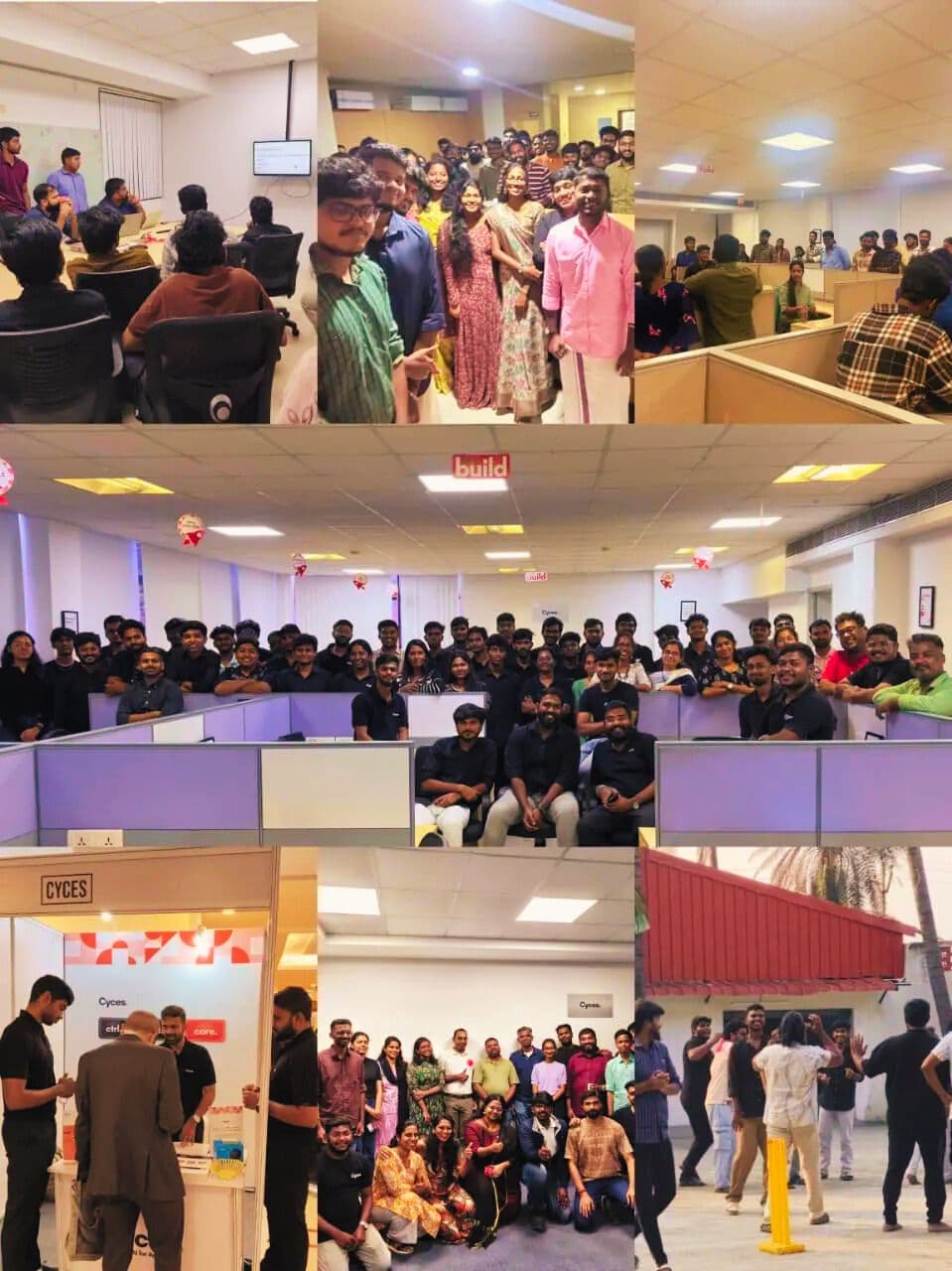
Team growth was a real part of 2025. We hired across roles and brought in students through campus hiring, with a focus on talent from leading universities in Tamil Nadu. Training and learning stayed central as the team scaled.
Culture did not take a back seat. The year included Pongal celebrations with rangolis and traditional wear, a Diwali potluck, Christmas activities, and a day outing to a beach resort in Chennai with games and team bonding. We also ran ergonomics and wellbeing sessions and internal learning shares that helped build confidence, capability, and shared ownership.
What 2025 set up
By the end of 2025, Cyces felt more grounded and more focused.
- We shipped and owned products, not just projects
- We expanded into new industries with higher stakes and more complexity
- We deepened post-launch responsibility with 24x7 support and stronger ops
- We adopted more AI-native ways of working internally, not just in demos
Technology will keep changing. Our job is to build systems people can trust.
2025 was our year to build those rails.
Our outlook for 2026
2025 was about building the rails. 2026 is about what we do with them.
There is a line NASA’s Jet Propulsion Laboratory tucked into the Perseverance landing parachute: “Dare Mighty Things.” That idea has been part of Cyces’ core operating principles for more than a year. We come back to it when we are choosing what to build, how big to think, and how much responsibility we are willing to take on.
In 2026, we plan to stay grounded, but be more fearless:
- Lean into the agent year with clearer points of view, not just prototypes
- Take bigger product bets, while keeping the same quality bar
- Treat trust as a product feature, through stronger support, monitoring, and post-launch ownership
- Go deeper on AI-first, AI-native ways of working, so more people can participate meaningfully in building and improving systems
Let's Dare Mighty Things Together. Stay Tuned...!
leveraging tech for
business growth
Cyces.